Warner Bros. decided to take a major risk by investing in the Vitaphone sound system for “Don Juan,” a silent film with some music and sound effects.
Then in 1927, the studio adapted Samson Raphaelson Broadway hit, The Jazz Singer—the plot was based on his short story, “The Day of Atonement.”
It was the first film which included actual musical numbers, though the rest of the narrative was non-talking.
Grade: B
| The Jazz Singer | |
|---|---|

Theatrical release poster
|
|
Al Jolson stars as Jakie Rabinowitz, son of the Jewish cantor Warner Oland. Rejecting family tradition, Jakie becomes a cabaret-entertainer, adopting the WASPish name Jack Robin.
When Jack visits his parents, he is warmly received by his mother (Eugenie Besserer), but he is rebuffed by his father, who feels that Jack is a “traitor” to his heritage. Initially, both father and son are stubborn and refuse to compromise and reconcile.
Melodrama kicks in, when on the eve of his biggest triumph, Jack receives word that his father is dying. Out of respect, Jack attends the religious services and sings the Kol Nidre in his father’s place.
All in all, about 18 minutes or The Jazz Singer qualify as “talkie” sequences, built around Jolson’s musical numbers.
The scene where Jolson’s chants “Blue Skies” to his mother was one of the movie’s exciting highlight. Reportedly, Jolson’s naturalistic mode pleased audience members, who cheered loudly during screenings.
Despite shortcomings of a sentimantal (borderlne schmaltzy) tale and amateurish acting that’s often stilted, The Jazz Singer was a box-office smash, running for months at many theaters across the country.
Jolson was never a great dramatic actor with range, but he was an amazing entertainer with a likeable, highly relatable personality.
Jolson went on to make a series of movies for Warner, including The Singing Fool, a part-talkie, and the all-talking features Say It With Songs (1929), Mammy (1930), and Big Boy (1930).

Jack Robin’s use of blackface in his Broadway stage act—a common practice at the time–became controversial later on, and it is now widely condemned as racist.
There have been several remakes of The Jazz Singer, most notably the one made in 1952, with Danny Thomas as the cantor’s son and Eduard Franz as his father.
A later entry, in 1980, starred the very British Laurence Olivier as the religious father.
Warner followed its partial-talkie, “The Jazz Singer,” with its first all-talkie, The Lights of New York, released in July 1928, a melodrama that grossed the huge amount of $2 million due to its novelty.
Louis B. Mayer, MGM’s top exec, made a fool of himself when declaing earlier the phenom of sound a “just a passing fad.”
However, always the practcial businessman, after observing the success of the early sound features, he decided to follow Warner’s pioneering efforts and produce talkies at MGM.
Gor example, he quickly added sound effects and music to the otherwise largely silent feature, White Shadows in the South Seas.
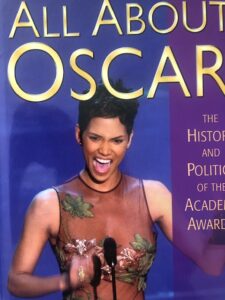
My Oscar book:
Oscar Nominations: 2
Adaptation: Alfred Cohn
Engineering Effects: Nugent Slaughter
Oscar Awards: 1
Special Award for Warner studio “for producing the pioneer outstanding talking picture, which has revolutionized the industry.”
Oscar Context:
The Best Adaptation Oscar went to Benjamin Glazer for Seventh Heaven (aka 7th Heaven), and the Engineering Effects Award to Roy Romeroy for Wings, which also won Best Picture.
Cast
Al Jolson as Jacob “Jakie” Rabinowitz (Jack Robin)
Bobby Gordon as Jakie Rabinowitz (age 13)
Warner Oland as Cantor Rabinowitz, Jakie’s (Jack Robin’s) father
Eugenie Besserer as Sara Rabinowitz, Jakie’s (Jack Robin’s) mother
May McAvoy as Mary Dale
Otto Lederer as Moisha Yudelson
Richard Tucker as Harry Lee
Yossele Rosenblatt as himself
Songs
“My Gal Sal” (music and lyrics by Paul Dresser; dubbed by unknown singer with Bobby Gordon onscreen)
“Waiting for the Robert E. Lee” (music by Lewis F. Muis, and lyrics by L. Wolfe Gilbert; dubbed by unknown singer with Bobby Gordon onscreen)
“Yussel, Yussel” (music by Samuel Steinberg, lyrics by Nellie Casman, 1923); heard as background music as Jolson walks through his ghetto neighborhood.
“Kol Nidre” (dubbed by Joseph Diskay with Warner Oland onscreen; sung also by Al Jolson)
“Dirty Hands, Dirty Face” (music by James V. Monaco, lyrics by Edgar Leslie and Grant Clarke; sung by Al Jolson)
“Toot, Toot, Tootsie (Goo’ Bye)” (music and lyrics by Gus Kahn, Ernie Erdman, and Dan Russo
“Kaddish” (sung by Cantor Yossele Rosenblatt)
“Yahrzeit Licht” (sung by Cantor Yossele Rosenblatt)
“Blue Skies” (music and lyrics by Irving Berlin; sung by Al Jolson)
“Mother of Mine, I Still Have You” (music by Louis Silvers, lyrics by Grant Clarke; sung by Al Jolson)
“My Mammy” (music by Walter Donaldson, lyrics by Sam M. Lewis and Joe Young; sung by Al Jolson)
Credits
Produced by Darryl F. Zanuck
Directed by Alan Crosland
Screenplay by Alfred A. Cohn, based on “The Jazz Singer” by Samson Raphaelson
Cinematography Hal Mohr
Edited by Harold McCord
Music by Louis Silvers
Production: Warner Bros.; Vitaphone Corporation
Distributed by Warner Bros.
Release date: October 6, 1927
Running time: 89 minutes; 96 minutes (with overture and exit music)
Budget $422,000
Box office $2.6 million
DVD: October 16, 2007 (on the occasion of the film’s 80th anniversary)