A poignant, often brutal expose of the American political system, Advise and Consent is one of Preminger’s best and also most controversial movies, not least due to a gay character who plays a major part in the plot.
Grade: A- (**** out of *****)
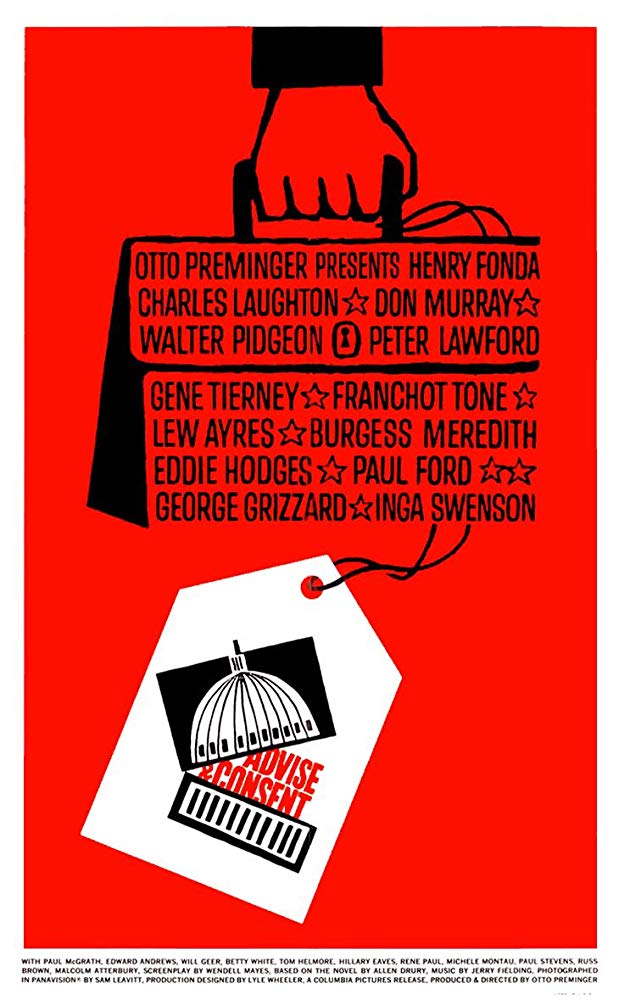
Containing a large number of characters, the ensemble features outstanding performances from an illustrious cast, which includes established stars (Henry Fonda, Charles Laughton, Gene Tierney), character actors (Walter Pidgeon), and newcomers (Don Murray).
Wendell Mayes’ script is based on Allen Drury’s best-selling, Pulitzer-Prize winning novel, which read like “Who’s Who in Washington,” sort of a hit-and-run foray among the political movers and shakers of the 1940s and 1950s.
In many ways, by offering a glimpse into the behind-the-scenes of political machinations and Washington intrigues, Advise and Consent is a companion piece to The Manchurian Candidate (also in 1962), with both films setting the trend of Hollywood’s future exposes, such as Sidney Lumet’s Fail Safe (1964), directed by Sidney Lumet and also starring Henry Fonda.
The tantalizing tale centers on Robert Leffingwell (Fonda), who has been appointed Secretary of State, and the long, arduous political process of confirming his appointment by the Senate.
Senator Bob Munson (Walter Pidgeon) and his cohorts are trying to push the appointment through, past opposition from vet politicians like Senator Seabright “Seb” Cooley (Charles Laughton), a crusty old man.
Young Senator Brigham Anderson (Don Murray), a freshman whose vote in support of the nomination is crucial, will not commit to his party leader Munson. This leads Senator Fred Van Ackerman (George Grizzard), a ruthless, power-hungry colleague, to attempt to blackmail Anderson into siding with his voting block. To that goal, he threatens to expose Anderson’s former homosexual activities, unless he votes “the right way.”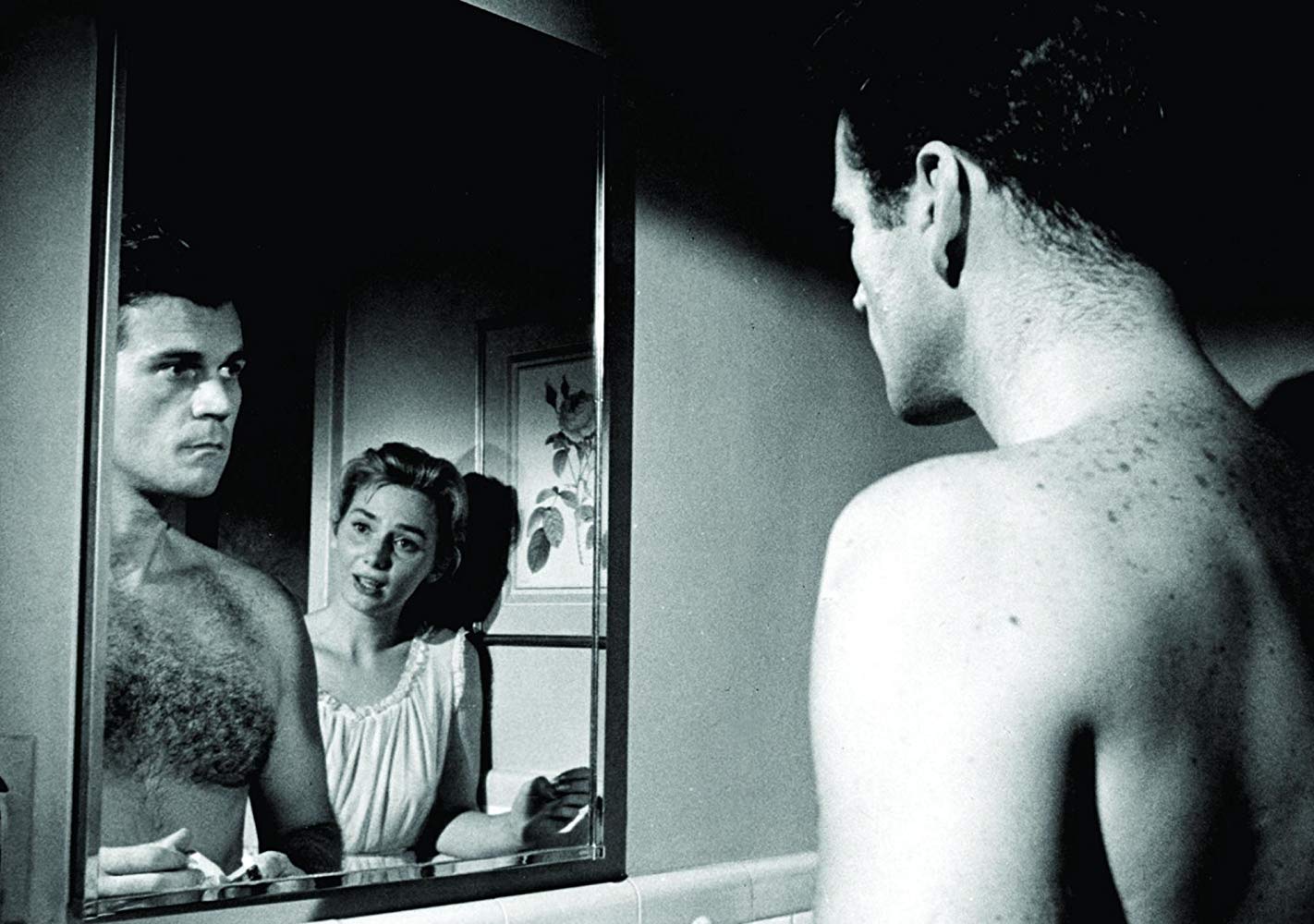
Anderson and his wife receive anonymous phone calls from Van Ackerman’s men, warning that unless the subcommittee reports favorably on Leffingwell, information will be disclosed about what happened with “Ray” in Hawaii.
Gay Directors, Gay Films? By Emanuel Levy (Columbia University Press, August 2015).
Gay Scene
In the movie’s most controversial scene, a worried Anderson visits fellow Army veteran, Ray Shaff, in New York. Shaff admits that he had sold evidence of a past gay relationship between the two.
Hudson, Anderson’s friend Smith, and others attempt to counsel the troubled chairman but, unable to reconcile his duty and his secret, Anderson commits suicide.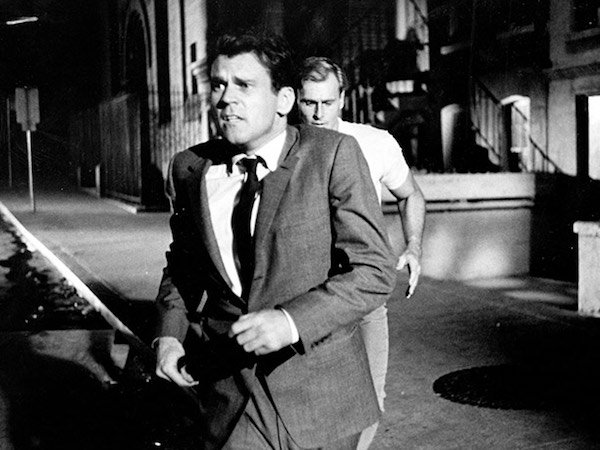
The President denies knowing about the blackmail to Munson and Hudson. He tells the majority leader that he is dying and that Leffingwell’s confirmation is vital. Munson criticizes Cooley for opposing the nominee but not exposing Fletcher, forcing Anderson to bear the pressure alone. Anderson’s death, nonetheless, permits the subcommittee and the Foreign Relations Committee to proceed with the nomination. Both report favorably to the full Senate.
In the Chamber, Cooley apologizes for his vindictiveness. While he will vote against Leffingwell and his “alien voice,” the senator will not ask others to follow. Munson, moved by Cooley’s action, cites the “tragic circumstances” surrounding the confirmation.
Although the majority leader will vote for Leffingwell, he permits a conscience vote by the others. Hudson’s quorum call and the majority leader’s refusal to yield the floor prevent Van Ackerman from speaking until Munson asks for the Yes and Nays, ending debate.
The majority leader tells Van Ackerman that were it not for the Andersons’ privacy, the Senate would censure and expel him. Van Ackerman then leaves the chamber before the vote.
Munson’s side is slightly ahead until Smith unexpectedly votes against Leffingwell. The majority leader prepares for the Vice President to break the tie in the nominee’s favor. Secret Service agents enter the chamber, delivering to Hudson a message. The Senate Chaplain announces that he will not break the tie–causing the nomination to fail–due to the fact that the President has died during the vote.
Unusual Ending
As he leaves with the Secret Service, Hudson tells Munson that he wants to choose his own Secretary of State. The film concludes when as Munson makes a motion to adjourn due to the former president’s death.
Challenging the Production Code, the movie pushed censorship boundaries with its depiction of a married senator who is blackmailed over a wartime homosexual affair. It’s considered to be the first mainstream American movie after World War II to show a gay bar.
Acting
Preminger also confronted the blacklist by casting left-wing actors Geer and Meredith.
In his last screen performance, Laughton, a latently gay actor (married to Elsa Lanchester), shines in a splashy role replete with nasty and witty line. The British Oscar winner was suffering from cancer during the shoot and died six months after the film’s release.
Though Henry Fonda received star-billing, his part, as a shadowy and controversial politico, was cut severely in the editing room. Preminger claimed that it was a necessity of the large number of characters, events, and subplots. As it is, the film’s running time, 140 minutes, is longer than was the norm of Hollywood dramatic films. Even so, Fonda’s role calls attention to his more established screen image, as a noble and dignified all-American hero. Only in the 1960s and 1970s, Fonda would deviate from his screen persona to play more villainous and morally ambiguous characters.
At the time, some critics felt that Preminger sensationalizes American politics, though the helmer’s approach was more precise and cautious than the usual.
Advise and Consent was released in 1962, a year before the John F. Kennedy’s Assassination, on November 22, 1963, a traumatic event that would forever change American politics and our perception of it.
“Advise and Consent” was more incisive and realistic than, say, Frank Capra’s political fable, “Mr. Smith Goes to Washington,” a film that’s been admired since its release, in 1939.
Significantly, though, both features proved to be unpopular with their role models, who refused to comment on them.
Cast
Henry Fonda as Robert A. Leffingwell
Charles Laughton as Senator Seabright “Seab” Cooley of South Carolina and President of the Senate
Don Murray as Senator Brigham “Brig” Anderson of Utah
Walter Pidgeon as Senate Majority Leader Robert “Bob” Munson of Michigan
Peter Lawford as Senator Lafe Smith of Rhode Island
Gene Tierney as Dolly Harrison
Franchot Tone as The President
Lew Ayres as Vice President Harley Hudson and former Governor of Delaware
Burgess Meredith as Herbert Gelman
Eddie Hodges as Johnny Leffingwell
Paul Ford as Senate Majority Whip Stanley Danta of Connecticut
George Grizzard as Senator Frederick “Fred” Van Ackerman of Wyoming
Inga Swenson as Ellen Anderson
Edward Andrews as Senator Orrin Knox of Illinois
Paul McGrath as Hardiman Fletcher
Will Geer as Senate Minority Leader Warren Strickland of Idaho
Betty White as Senator Bessie Adams of Kansas
Malcolm Atterbury as Senator Tom August of Minnesota, chairman of Foreign Relations Committee
J. Edward McKinley as Senator Powell Hanson of New Mexico
Bill Quinn as Senator Paul Hendershot of Indiana
Credits:
Distributed by Columbia
Release date: June 6, 1962
Running time: 140 Minutes