| The Diary of Anne Frank | |
|---|---|

Film poster
|
|
Stevens’ epic-length saga aims at offering an intimate account of human survival and heroism, centering on the harrowing ordeal and brave behavior of eight Jews, all hiding in an attic in Nazi-occupied Amsterdam.
While the exteriors were shot in Amsterdam, the rest of the film was made on studio sets. William Mellor’s fluid camera work communicates the muted horror of the prohibitive confinement in a restricted space.
The film’s major flaw is the casting of the then inexperienced Millie Perking in the role of Anne Frank since she is the center of the narrative and we experience the ordeal through her eyes. Perkins looks physically right, but she doesn’t sound or act right. The part calls for an actress who could make the audience understand and feel the power of Anne’s emotional truth, her growing pains, her feelings as a girl on the verge of becoming a young woman.
Critics at the time pointed out that Millie Perkins lacked the natural glow and exquisite expressiveness that Susan Strasberg (daughter of acting guru Lee Strasberg) had shown in the stage production. (Ironically, as a screen actress, Strasberg herself lacked those qualities).
Anne’s Neighbors
The Van Daan couple represents the reality and humanness of the older people in the attic. Shelley Winters gives a flashy, Oscar-winning performance as the crude yet sad and human Mrs. Van Daan, mother of Peter (Richard Beymer). Winters excels as a simple woman, limited by meager resources who can barely cope with the situation. Later on, she goes to pieces when her greedy husband wants to sell her fur coat.
To achieve the realistic heft of Mrs. Van Daan, Shelley Winters put on extra 15 pounds before shooting began, and then as the story progresses and her nutrition drops, she took off 25 pounds.
Her weakling of a husband (Lou Jacobi) is irksomely sluggish and pathetically lax. Mr. Van Daan misses his previous comforts and food, and in the end, he turns into a thief to fill his stomach.
Just before being arrested, Otto Frank observes: “For the past two years we lived in fear, now can live in hope.”
For her part, Anne expresses wishes that her diary will be found and read one day.
The epilogue unmistakably trying to send an optimistic message. It goes back to 1945, when Otto tells Miep and Kraler that after being released from the concentration camp he learned how Edith, Margot, the Van Daans, and Dussell had perished.
Though he had always hoped that Anne would somehow survive, he then sadly reveals that while in Rotterdam, he met a woman who had been in Bergen-Belsen with Anne and she confirmed to him the death of his daughter.
Otto then glances at Anne’s diary and reads, “In spite of everything, I still believe that people are really good at heart.”
Stevens’ direction is painstakingly meticulous in attention to detail, but overall it is too literal and uninspired. For a while, he captures the illusion of action, tension, and suspense, despite the constriction of space. Through some exterior shots of the German police searching, and sounds, he conveys the feeling of unbearable confinement.
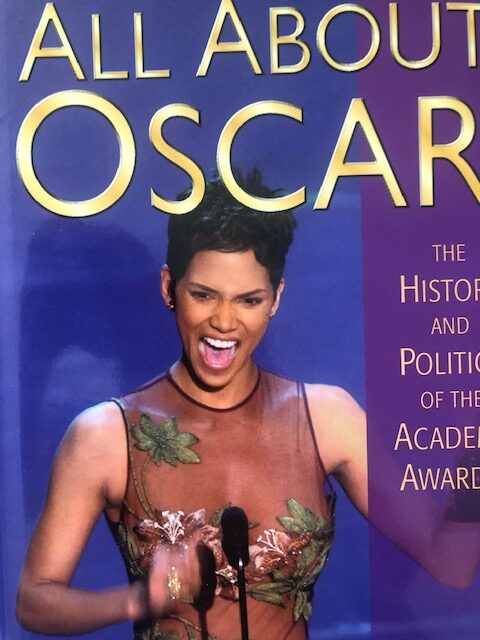
Oscar Nominations: 9
Picture, produced by George Stevens
Director: George Stevens
Supporting Actress: Shelley Winters
Supporting Actor: Ed Wynn
Cinematography (b/w): William C. Mellor
Art Direction-Set Decoration (b/w): Lyle R. Wheeler and George W. Davis; Walter M. Scott and Stuart A. Reiss
Costume Design (b/w): Charles LeMaire and Mary Wills
Scoring of a Dramatic or Comedy Picture: Alfred Newman
Oscar Awards: 3
Supporting Actress
Cinematography
Art Direction
Oscar Context
In 1959, William Wyler’s historical epic “Ben-Hur” swept most of the Oscars, including Best Picture and Best Director.
CAST:
Millie Perkins as Anne Frank
Joseph Schildkraut as Otto Frank (reprising stage role)Shelley Winters as Petronella Van Daan
Richard Beymer as Peter Van Daan
Gusti Huber as Edith Frank (reprising stage role)
Lou Jacobi as Hans Van Daan (reprising stage role)
Diane Baker as Margot Frank
Douglas Spencer as Kraler
Dodie Heath as Miep Gies
Ed Wynn as Albert Dussell
CREDITS
Produced, directed by George Stevens
Written by Frances Goodrich and Albert Hackett, based on The Diary of Anne Frank 1955 by Frances Goodrich and Albert Hackett; The Diary of a Young Girl 1947 by Anne Frank
Cinematography William C. Mellor
Edited by David Bretherton, William Mace, Robert Swink
Music by Alfred Newman
Distributed by 20th Century-Fox
Release date: March 18, 1959
Running time: 179 minute
Budget $3.8 million
Box office $2.3 million (est. US/ Canada rentals)