John Steinbeck’s book, “East of Eden,” was published in 1952, the same year that Fred Zinnemann’s film version of Carson McCuller’s book “Member of the Wedding” was released theatrically.
In its exploration of adolescence angst, Elia Kazan’s film is a suitable companion piece to “Member of the Wedding,” which is about a young female adolescent (terrifically played by Julie Harris).
It may be a coincidence that the protagonists of these films share a similar name, Adam. In “Member of the Wedding,” it’s Frankie’s last name; in “East of Eden,” the patriarch’s first name is Adam Trask.
There’s another link: Julie Harris, the star of “Member of the Wedding,” who plays Abra, the girl both boys love in “East of Eden.”

The two films also exhibit similar ideology in the “remedy” that they prescribe for the problems of identity formation, loneliness, alienation, and integration into a larger, more meaningful group, be it the nuclear family or society at large.
“East of Eden” suffers from an excessive theatrical sensibility, stemming from the screenplay by Paul Osborn (better known as a playwright) and Kazan’s experience as a stage director who relies on theatricality in most of his movies.
Unlike “A Rebel Without a Cause,” the other great movie that James Dean made in 1955, “East of Eden” has not held up particularly well, but it remains historically significant as the picture that established James Dean as a star, for which he received his first Best Actor Oscar nomination.
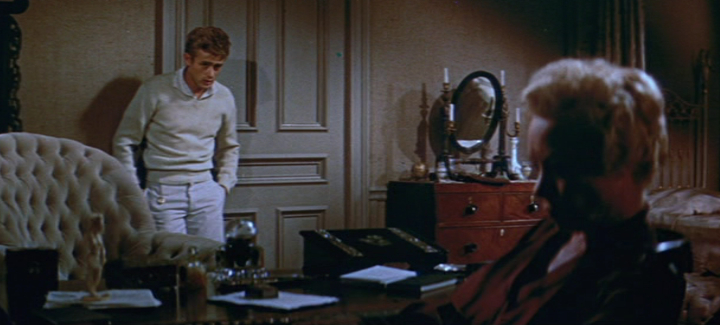 The narrative begins with a card: “In Northern California, the Santa Lucia Mountain, dark and brooding, stand like a wall between the peaceful agricultural town of Salinas and the rough and tumble fishing port of Monterey, fifteen miles away.” What connects the town to Monterey is a freight train, which is used extensively in the story.
Set in 1917, just prior to the U.S. entry into World War One, the narrative centers on the Trask family, headed by Adam (Raymond Massey), whose wife Cathy (Jo Van Fleet) has walked out on him years back, leaving him the responsibility of raising two sons: Cal (James Dean) and Aron (Richard Davalos).
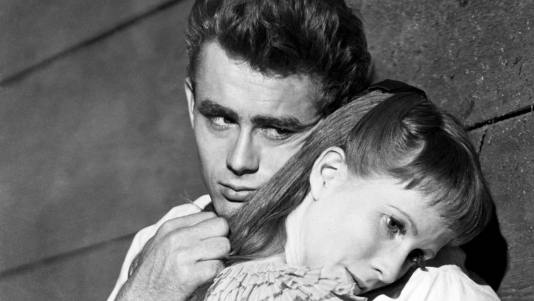 For years, the patriarch maintains that their mother had died, but when the story begins, Cal discovers that Cathy is actually Kate, a madame running a fancy brothel. Later, Cal finds out that a scar on his father’s shoulder, which he had explained as a memento of an Indian attack, was caused by his mother’s six-gun. Cal has a natural, instinctual rapport with his mother, even though at first she rejects him.
On his second visit to her place, Kate realizes that Cal is a reflection of her own “wild nature”–Kate too could not conform to the rigid domesticity demanded by her husband, which is an unusual element of sexual politics for a film made in the 1950s.
“East of Eden” deals with Cal’s desperate search for roots, specifically his need to renew the acquaintance with his mother and to regain the love of his father. After some painful experiences, Cal rediscovers the power of family ties and the meaning of romantic love. These two kinds of love, the film says, are needed by every adolescent in order to grow up as a healthy and “normal” person. It’s significant that in the first sequence, Cal follows his mother, and in the last, he is in the room of his dying father. For most of the film, however, Cal is alone, isolated from everyone.
For a film made as an epic, “East of Eden” contains quite a small number of characters. Most of the scenes unfold as melodramatic confrontations between two characters (Cal and his mother, Cal and his father), in which revelations are declared and confessions made. The narrative is structured as a Biblical allegory. Adam Trask is a distant, stern, self-righteous father, who devotes all of his attention to Aron, his “good” son. Cal is the “bad” son, often referred to as an animal and compared to his mother Kate, a bad woman running a saloon. For aa 1950s film, it’s interesting that Kate is not “punished” and does not die, as she does in the book.
Abra is a good girl, though, by her own admission, she too has a streak of badness in her. As such, she serves as the ideal mediator between the two brothers and between Cal and his father. Though engaged to Aron, she is clearly in love with Cal. Albra is the only person Cal can confide in–being motherless, she knows the meaning of loneliness.
Throughout the film, Cal is told he is “nasty, mean, and scary.” But he is basically a good, warm, passionate boy, whose entire behavior is motivated by frustration for not being loved by his father. Jealous of his father’s undivided attention to his brother, Cal attempts every possible means to regain his love. Trask’s business dream is to refrigerate produce, which would then be transported to the East, for which purpose he bought an icehouse.

Cal first attempts to get his father’s attention through pragmatic means, by stealing a coal chute to load the produce. Instead of praise, however, he gets reproached. On his father’s birthday, Cal presents him with the money he had saved, but his father reprimands him for profiteering. Aron takes the spotlight, when he announces his special birthday present: his engagement to Abra.
Most of the film was shot on location, but we don’t get an overall feel of Salina as a town. Moreover, important events, such as the breakout of WWI are treated as occurrences experienced by the brothers from the outside. Neither brother is idealistic or collectively oriented–unlike other heroes of small-town movies during the War. Aron is a conscientious objector who opposes the War on moral grounds, whereas Cal perceives the War in pragmatic terms, as an opportunity to go into the beans business, which will help his father.
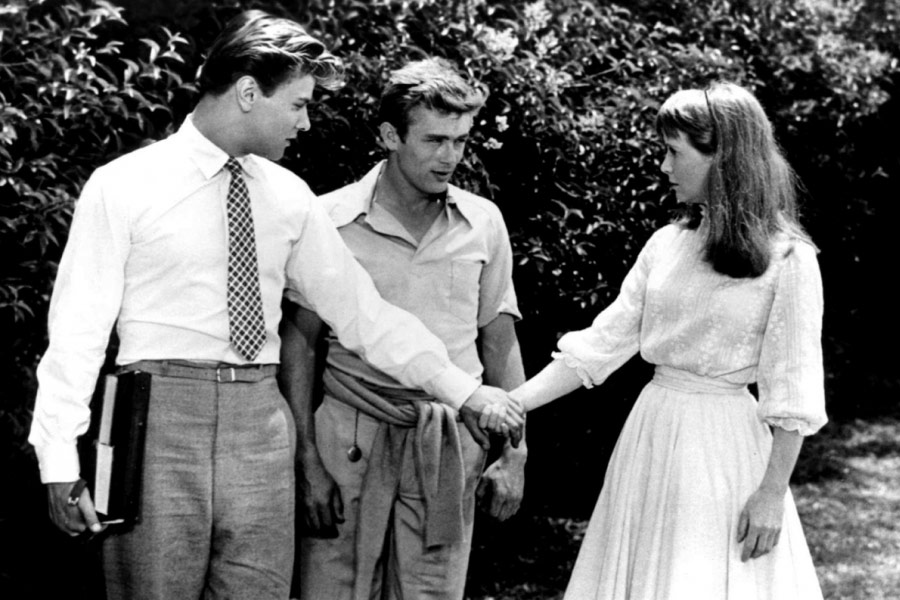 Racism is a major source of tension in town. When the U.S. joins the War, a mob attacks Mr. Albrecht, a previously respectable German-American citizen; it’s Cal who interferes and prevents bloodshed. Sheriff Sam Quinn is a benevolent and liberal figure (like the police officer in “Rebel Without a Cause”), a far cry from authority figures in films of the 1960s and 1970s. The sheriff functions as a sensitive paternal figure that understands Cal better than his birth father. Advising and intervening when needed, Sheriff Quinn is the one who confirms Cal’s suspicion that Kate is his mother, and he is also the one who tells Cal how his father went into a shell after she left him.
Some of the film’s symbols are heavily-handed. For instance, the icehouse could be seen as Adam’s cold and emotionally empty life, after his wife abandons him. Interestingly, the romance between Aron and Abra evolves in the icehouse, an enclosed industrial space, signifying emotional chill and lack of intimacy. Watched by Cal, the scene evolves into violence, when he literally attacks the ice, sending huge blocks of it down the chute. Cal’s violence could be interpreted as an act ending his previously icy life, which is now shattered. By contrast, the romance between Cal and Abra is carried out in Nature, in the open fields, or late at night, outside her bedroom in a scene reminiscent of Romeo and Juliet; the couple exchanges their first kiss in an amusement park.
As the narrative progresses, “East of Eden” becomes an overtly message film. In the next to last scene, Abra explains to the stroke-blighted Adam what he needs to do in order to “cure” his son’s problems. “You have to give him some sign that you love him,” she says, “Or else he’ll never be a man.” “It’s awful not to be loved,” she says, “It makes you cruel.” Cal is not a rebellious boy; all he wants is to gain his father’s love and respect, for which he is willing to sacrifice himself completely.
The film achieves its resolution, when the dying Adam asks Cal to get rid of the nurse: “Don’t get anyone else. You stay with me. You take care of me.” Cal, the allegedly weaker son, turns out to be emotionally stronger than his brother. Learning the truth about their mother shatters Aron completely; in a spasm of hysteria he shatters a window with his head.
The narrative ends with a major role reversal. Cal, the outsider, becomes insider, fully integrated into his family and town. Aron, the former insider, literally becomes an outsider, when he enlists into the Army, out of despair, not idealism.
Oscar Records
This was James Dean’s big screen debut, for which he received an Oscar nomination. It was followed by two other great films: Rebel Without a Cause and Giant. East of Eden was the only one of Dean’s three major films to open theatrically before his death, on September 30, 1955.
Some critics consider East of Eden to be Kazan’s most fully realized work, but, for me, the film is too emotionally overwrought, though all the performances are terrific. If I had to choose Kazan’s best youth picture I would single out Splendor in the Grass, starring Warren Beatty (in a splashy debut) and Natalie Wood.
Oscar Nominations: 4
Director: Elia Kazan
Actor: James Dean
Supporting Actress: Jo Van Fleet
Screenplay (Adapted): Paul Osborn
Oscar Awards: 1
Supporting Actress
Cast
Abra (Julie Harris)
Cal Trask (James Dean)
Adam Trask (Raymond Massey)
Aron Trask (Richard Davalos)
Sam (Burl Ives)
Kate (Jo Van Fleet)
Will (Albert Dekker)
Ann (Lois Smith)
Mr. Albrecht (Harold Gordon)
Credits
Warner
115 Minutes
Produced and directed by Elia Kazan
Screenplay: Paul Osborn (nased on the novel by John Steinbeck)
Camera: Ted McCord
Editor: Owen Marks
Music: Leonard Rosenman
Art Direction: James Basevi and Malcolm Bert
Costume Design: Anna Hill Johnstone