A key American film of an era that’s considered now to be Hollywood’s last Golden Age (1967-1975), Five Easy Pieces, Bob Rafelson’s superlative character study, won the Best Picture from the New York Film Critics Circle (NYFCC).
More significantly, it established Jack Nicholson (born in 1937), fresh off from his success in Easy Rider (for which he received a Best Supporting Actor nomination, his first of 13 subsequent nods) the previous year, as the foremost actor of his generation, alongside with the slightly younger Al Pacino (ne in 1940) and Robert De Niro (1943).
Our Grade: A- (****1/2 out of *****)
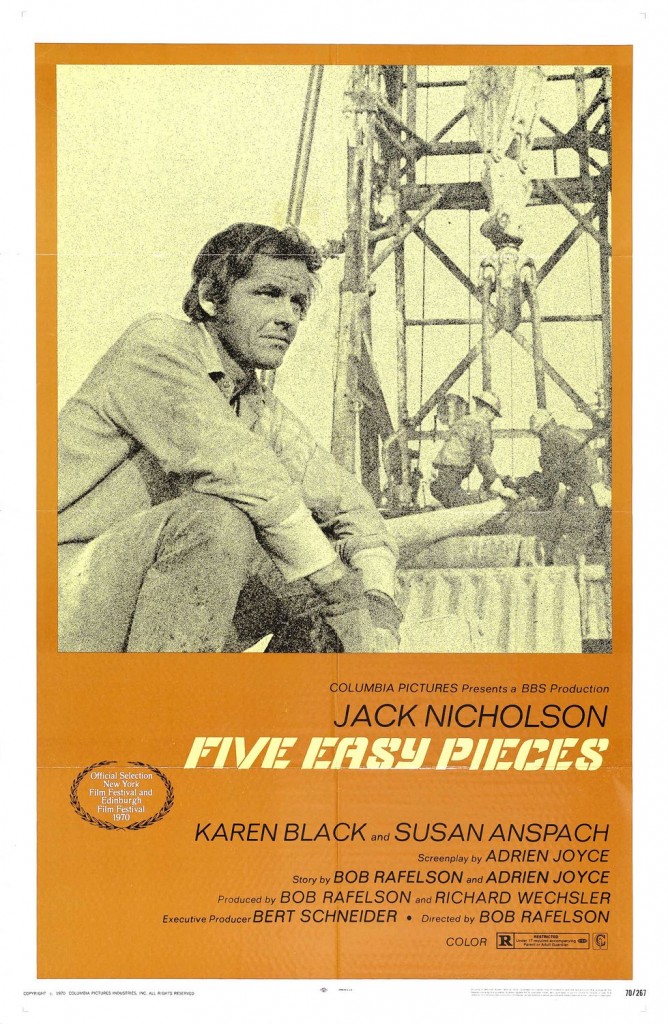
Adrien Joyce, who co-wrote the script with director Rafelson, said she had based the chief character partly on her impressions of Jack Nicholson himself and partly on her own dead brother.
Film’s Title
The opening credits enlist the five classical piano pieces played out (by credited pianist Pearl Kaufman) and referenced in the film’s title (See below, music section)
Combining elements of the road movie, which captures the vistas of the North West with the more universal theme of “search for identity,” Five Easy Pieces may be too self-conscious in trying to be a new, modernist tale about eccentric characters, laced with some absurdist-satirical humor, and determined to have a more open and ambiguous ending, lacking the more conventional morality of Classic Hollywood Cinema.
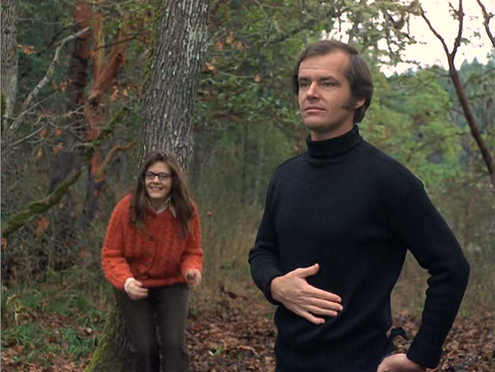
One of the few honest American films about social class, downward mobility, family, and alienation, “Five Easy Pieces” is more of a character and mood piece than a straightforward, plot-driven narrative. Considering that the film was about alienation, marked by a pessimistic mood, and influenced by European filmmaking in approach and style, the movie was remarkably popular at the box-office, benefiting from the success of the a cycle of youth movies at the time.
Jack Nicholson plays Bobby Dupea (his full name is Robert Eroica), an upper-middle class dropout, who now works as oil rigger in the California fields, spending his leisure time in bowling alleys and beer pubs with his girlfriend waitress Rayette Dipesto (Karen Black), before taking a trip up North to visit his family. In South California, Bobby lives with Rayette in a dreary apartment in a drab working-class milieu.
We learn that Bobby had escaped from his suffocating bourgeois family, headed by Nicholas Dupeau (William Challee), his patronizing concert-artist father, who live with daughter Tita (full name is Partita, played by Lois Smith), a dowdy, scatter-brained, concert artist.
Back at his folks house, Bobby jilts his pregnant mistress for his brother Carl’s fiancee, Catherine von Oost (Susan Anspach), a cool, high-cultured, and suave lady who’s in fact phony and pretentious.
After the father suffers a stroke, hiding his emotions, Bobby says: “I’m sorry it did not work out.”
“Five Easy Pieces” also serves as a road movie. Along the journey, some colorful and eccentric characters are introduced. Among them is Palm Apodaca (Helena Kallianiotes), a bitter lesbian hitchhiker obsessed with filth and headed with her lover to Alaska, where it’s cleaner, because as she says, “there are no men there.”
While the film dissects the protagonists’ real and chosen families, trying to combine a sociological (social class) and psychological (identity, psyche), it still follows mainstream Hollywood by locating the narrative’s crises and (ambiguous) resolutions within the individual himself, thus embracing the more prevalent psychologistic perspective.
Thematically, Five Easy Pieces merges two prevalent and uniquely American concerns: the unease and unrest of the late 1960s in the wake of the Vietnam War and the more traditional American’s desire for personal autonomy and self-fulfillment.
Like other films of the times, Five Easy Pieces is a tale of young man with an acute identity crisis, a marginal man (in sociological terms) who doesn’t fit in anywhere. Hailing from a bourgeois clan of means and intellectual background, Bobby had fled his culture-worshipping family, first for Las Vegas’ honky-tonks, then to the manual labor of oil fields, and finally hitchhiking to Alaska.
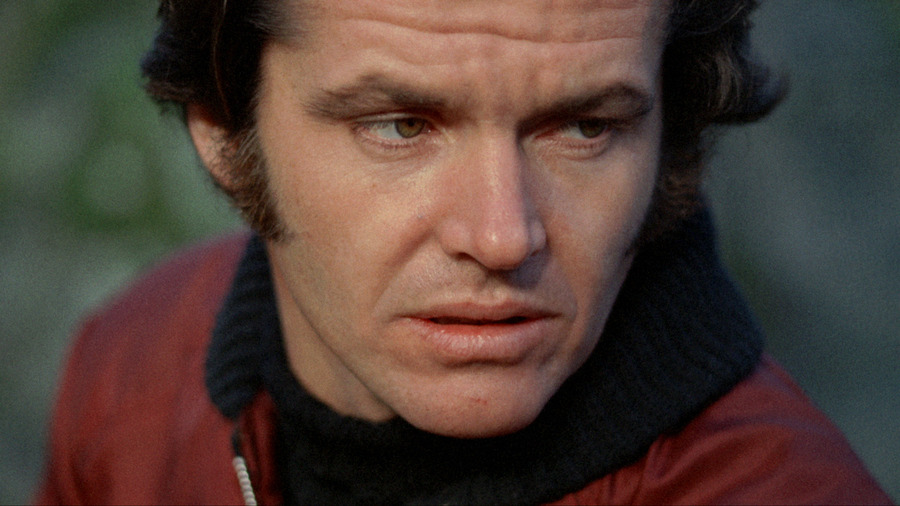
As a protagonist, Bobby is an outsider, but he is not a hippie who seeks solidarity and pleasure in the Haight-Ashbury sex-drugs-music subculture. That may have been a reflection of Nicholson’s age, who was 33 when the film was made. However, like anti-heroes of its era, Bobby is full of anger and frustration, which are manifest in a showdown in a diner with a truck-stop waitress, who refuses to make any substitution in menu. (See memorable lines below).
A dropout, Bobby has adopted sort of a proletarian lifestyle, which is visually conveyed through the hot, dusty oil fields of California.
In contrast, his family is all restraint and emotional sterility, psychological attributes reinforced by the landscape and climate of rain and cold. It’s also hard not to notice the physical disability of Bobby’s family members: His kind sister Tita is fat and neurotic, his brother Carl bears a neck brace (sign of impotence), and his father is mute and immobilized by a stroke. In other words, he’s surrounded by and rebels against phonies and obtuse snobs, who have betrayed the essence of the American Dream.
In his blend of toughness and sensitivity, Bobby is a reincarnation of American outlaw (anti) heroes of yesteryear, such as William Holden in “Golden Boy,” or John Garfield in “Humoresque,” both playing artists who compromised for a boxing or other materialistic and less deserving career.
The film proceeds by delineating a series of contrasts and oppositions, between the blue-collar universe of the Southern California oil fields and the culture of beer, bowling, and country music (Tammy Wynette) and classic Chopin music (giving the film its title) and country music. There gulfgreat divide–between intellectual and musical upper class family and the more physical and grounded lower class
In the original tale, Bobby and Rayette’s go over a cliff in their car, and Rayette survives, but Rafelson and his scenarist have opted for a more open and ambiguous ending, in which Bobby deserts Rayette at a gas station and heads up North, though there is no “home” for him.
“Five Easy Pieces” bears echoes of other counter-cultural and anti-authoritarian films of the late 1960s and early 1970s, such as “The Graduate,” “Easy Rider,” “Charlie Bubbles,” and “The King of Marvin Gardens,” which Jack Nicholson directed in 1972.
In keeping with the spirit of the times, the film contains a lesbian role (one-dimensional): Helena Kallianiotes is cast as Palm Apodoca, a tough lesbian hitchhiker on her way to Alaska to escape what she describes as “America’s accumulated filth.”
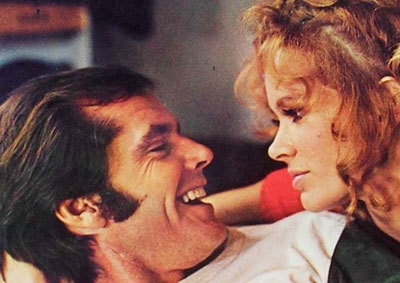 Nicholson and Karen Black
Memorable Lines:
Sexism of Bobby’s Character:
Rayette: “Ill go out with you, or I’ll stay in with you, or I’ll do anything that you like for me to do, if you tell me that you love me.”
Bobby: “It you wouldn’t open your mouth, everything would be just fine.”
Diner Scene:
When a waitress refuses to serve him plain toast because it is not on the menu.
Bobby to Waitress: “Now all you have to do is hold the chicken, bring me the toast, give me a check for the chicken salad sandwich, and you haven’t broken any laws.”
Music: Five Easy Pieces
Chopin, Fantasy in F minor, Op. 49, played by Bobby on a moving truck;
Bach, Chromatic Fantasia and Fugue, BWV 903, played by Bobby’s sister Partita in recording studio;
Mozart, Piano Concerto No. 9 in E-flat major, K. 271, played by Bobby’s brother Carl and Catherine when Bobby arrives at the house;
Chopin, Prelude in E minor, Op. 28, No. 4, played by Bobby for Catherine;
Mozart, Fantasy in D minor, K. 397.
Karen Black: Quintessential Actress of the 1970s
In “Easy Rider,” Karen Black played one the prostitutes Nicholson encounters in New Orleans. Based on her turn, Nichols recommended director Rafelson to cast her opposite him in “Five Easy Pieces.” It was a smart move for as Rayette Dipesto, the not-too-bright but warmhearted waitress in love with a man fleeing from his past, Black gives an utterly credible, Oscar-nominated performance. Yet there’s no escape feeling Nicholson’s misogyny, which was one of the contradictory characteristics of the New American Cinema.
Cast
Jack Nicholson as Robert “Bobby” Eroica Dupea
Karen Black as Rayette Dipesto
Susan Anspach as Catherine Van Oost
Lois Smith as Partita Dupea
Ralph Waite as Carl Fidelio Dupea
Billy “Green” Bush as Elton
Irene Dailey as Samia Glavia
Toni Basil as Terry Grouse
Helena Kallianiotes as Palm Apodaca
William Challee as Nicholas Dupea
John Ryan as Spicer
Fannie Flagg as Stoney
Marlena MacGuire as Twinky
Sally Ann Struthers as Shirley “Betty”
Lorna Thayer as Waitress
Richard Stahl as Recording Engineer
Credits
Directed by Bob Rafelson
Cinematography: Laszlo Kovacs
Editing: Gerlad Shepard, Christopher Holmes
Costumes: Bucky Rous
Music: Bach, Mozart, Chopin
Running Time: 96 Minutes
My Oscar Book
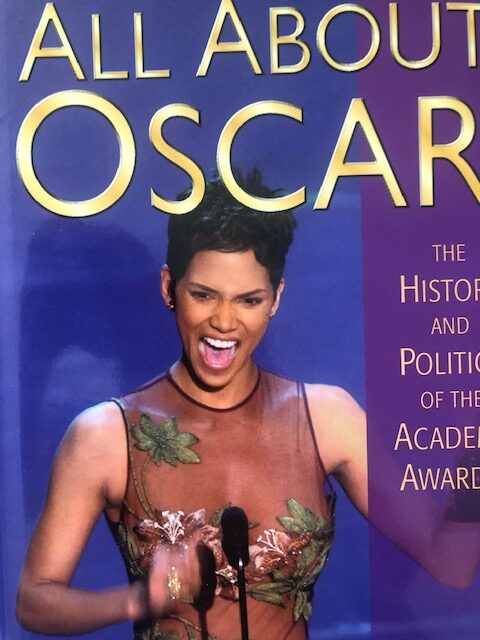
Oscar Nominations: 4
Picture, produced by Bob Rafelson and Richard Wechsler
Story and Screenplay (Adapted): Bob Rafelson and Adrien Joyce
Actor: Jack Nicholson
Supporting Actress: Karen Black
Oscar Awards: None
Oscar Context
In 1970, the Oscar winner “Patton” competed for the Best Picture with the schlocky disaster flick “Airport,” which inexplicably received 10 nominations but won only one (Supporting Actress to Helen Hayes); “Five Easy Pieces,” which was nominated for 4 but didn’t win any Oscars; the blockbuster “Love Story,” which won one out of its 6 nominations; and Robert Altman’s military satire “M-A-S-H,” that later became a popular TV series.