(French title Le Charme discret de la bourgeoisie)
The seminal Spanish director Luis Bunuel won the 1972 Best Foreign Language Film Oscar for his charming surreal fable, The Discreet Charm of the Bourgeoisie, which he co-wrote with his frequent collaborator, Jean-Claude Carriere.
Grade: A (***** out of *****)
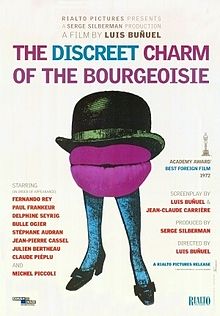
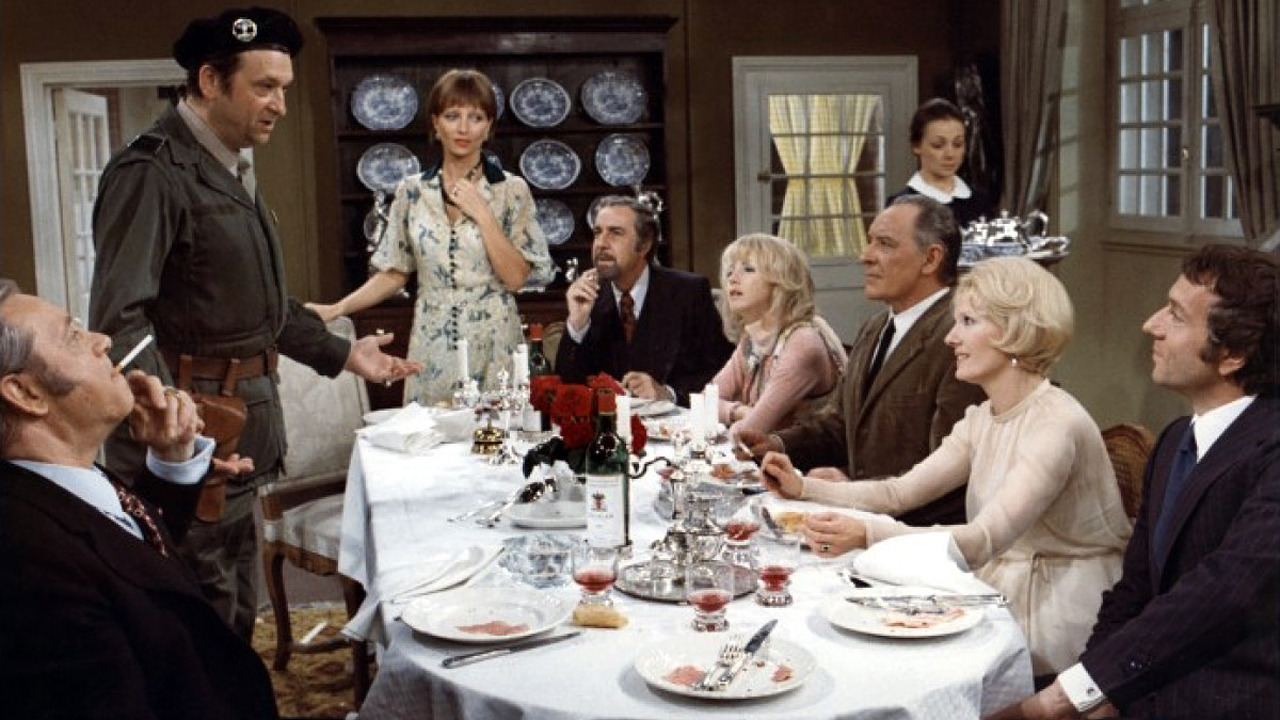
The narrative concerns a group of upper middle-class friends, who are attempting to have dinner together–despite numerous and continuous interruptions.
The film consists of thematically linked scenes. Structurally, there are five gatherings of the group of bourgeois friends, and four dreams of different characters.
The beginning of the film focuses on the gatherings, while the latter part focuses on the dreams.
There are also scenes involving other characters, including a Latin American female terrorist from a fictitious Republic of Miranda.
The bizarre events are accepted by the characters, even if they are impossible or contradictory. A recurring scene depicts the six people walking silently but purposefully on a long country road toward a mysterious destination
The film begins with a bourgeois couple, the Thévenots (Frankeur and Seyrig), accompanying M. Thévenot’s colleague Rafael Acosta (Rey) and Mme. Thévenot’s sister Florence (Ogier), to the house of the Sénéchals, the hosts of a dinner party.
Alice Sénéchal (Audran) is surprised to see them, noting that she expected them the following evening and has no dinner prepared. The guests invite Mme Sénéchal to join them for dinner at a nearby inn.
The inn is locked. They knock and are invited in, despite the waitress’ reluctance and an ominous mention of “new management.”

There are no diners, but there is sound of voices from an adjoining room. It turns out that the manager died a few hours earlier and his former employees are holding vigil, awaiting the coroner. The party hurriedly leave.
In a short entr’acte, set in the Embassy of Miranda, the ambassador – Acosta – meets with Thévenot and Sénéchal to discuss a large cocaine deal. Acosta sees a young woman selling clockwork animal toys outside the embassy. He shoots one of the toys and the woman runs off; she is a terrorist, he says.
Two days later, the bourgeois friends attempt to have lunch at the Sénéchals, but the couple escape to the garden to have sex.
One of the friends takes this as a sign that perhaps the Sénéchals are aware the police are coming (fearing the discovery of the men’s involvement in cocaine trafficking) and were leaving to avoid arrest. The party leaves again in panic.
When the Sénéchals return after making love, their friends are gone but they meet a bishop. He greets them in their gardener’s clothing, and they angrily throw him out. When he returns in his bishop’s robes, they embrace him with deference, exposing their prejudice, snobbery, and hypocrisy. The bishop wishes to be their gardener. He relates his childhood—how his parents were murdered by arsenic poisoning. Later on in the film, he goes to bless a dying man, but when it turns out that the man had killed the bishop’s parents, he first blesses him, then fires a shotgun, killing the man.
The women visit a tea house, which turns out to have run out of all beverages—tea, coffee, milk, and herbal tea; there’s only water. While they are waiting, a soldier tells them about his childhood and how, after the death of his mother, his education was taken over by his cold-hearted father. The soldier’s mother (as a ghost) informs him that the man is not his real father, but in fact killed the soldier’s father in a duel. The soldier poisons and kills the culprit.
Various other aborted dinners ensue, with interruptions including the arrival of a group of French army officers who join the dinner, or the revelation that a French colonel’s dining room is a stage for theatrical performance, during a dream sequence. Ghosts appear in disconcerting dream sequences.
Buñuel plays tricks, luring them toward fine dinners that they expect, and then repeatedly frustrating them in inventive ways. They bristle, and politely express their outrage, but they never stop trying; they relentlessly pursue all that they desire, as though it were their natural right to have others serve them. He exposes their sense of entitlement, hypocrisy, and corruption.
In the dream sequences, he explores their intense fears—not just of public humiliation, but of being caught by police, and mowed down by guns. At least one character’s dream sequence is later revealed to be embedded in another character’s dream sequence. As the dreams-within-dreams unfold, Buñuel is also playing tricks on his audience, trying to make sense of the story.
Luis Bunuel’s delicious comedy of errors is a direct descendant of his ferociously audacious surreal “L’Age d’Or” and his disturbingly allegorical, “The Exterminating Angel.” Like its predecessors, “Discreet Charm of the Bourgeoisie” is a satire on the bourgeoisie, the clergy, the military, and their trivial, conformist lives. However, compared with “L’Age d’Or,” which was banned from public view, and “Exterminating Angel,” which left its audience puzzled and confused, “Discreet Charm of the Bourgeoisie” scandalizes no one, which may explain why the film garnered unanimous critical acclaim.
Bunuel explained his relative restraint in this film in the following way: “I feel less and less inclined toward violence. Scandal and violence are no longer useful. They have lost their punch. I now say with humor what I used to say with violence.”
Bunuel’s most reliable strategy of attack has always been dark and subtle humor. “Discreet Charm of the bourgeoisie” has been described as his most light and funny work to date.
Bunuel’s strategy is not to focus upon individual actors, but chooses instead a team of six characters to carry the comedy forward like a troupe of carefully understated clowns.
The narrative unfold as a series of dreams within dreams (told in flashbacks), and at first, it’s hard to distinguish what’s real and what’s fantasy. Like other films, reality and illusion blur into one with wickedly delicious comic results.
Thematically, the impassivity of the bourgeoisie emphasizes its rigidity and conservatism. The six characters seem to live in a social vacuum, composed of the same people, who repeat the same activity over ad over again. Their gatherings are usually marked by inane dialogue, and are often dedicated to the discussion of their taste in food.

Oscar Nominations
“Discreet Charm of the Bourgeoisie” deservedly won the Oscar Award for the Best Foreign-Language Film. The film was also nominated for Screenplay (Original) by Luis Bunuel and Jean-Claude Carriere.
Oscar Context
In 1972, “Discreet Charm of the Bourgeoisie” competed against “The Dawns Are Here” from the Soviet Union, “I Love You Rosa” from Israel, “My Dearest Senorita” from Spain and “The New Land” from Sweden.
The Best Original Screenplay Award went to Jeremy Larner for “The Candidate.”
French with English subtitles Running Time: 100 minutes