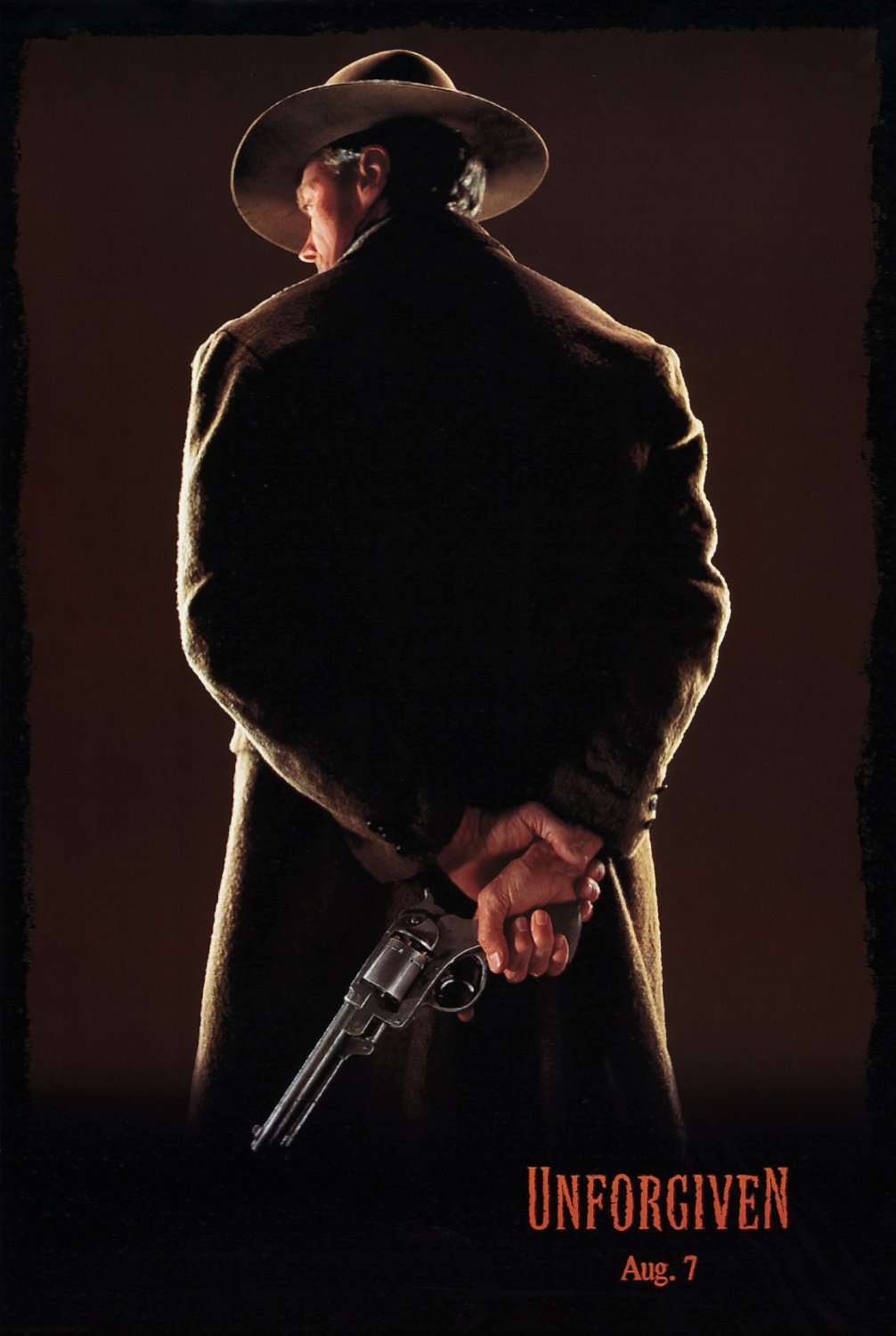
 For half a century, the Western movie was a staple–the bread and butter–of the Hollywood industry. Then, in the late 1960s, the Western died as a genre. The mythology of the frontier seemed to have lost its appeal; space mythology (Star Wars and its variants) became the new frontier in American culture.
Western movies–some good ones–continued to be made sporadically, like Altman’s McCabe and Mrs. Miller or Sam Peckinpah’s Pat Garrett and Billy the Kid, but they were all revisionist works that provided commentary on the genre’s conventions.
Please read our review of Eastwood’s Oscar nominee, American Sniper, the most socially significant and commercially successful film of 2014.
When John Wayne, arguably the most important Western star in history, passed away in 1979, Clint Eastwood remained the only major actor committed to the genre. And why not? After all, it’s the long-running Western TV series Rawhide that established him as a screen persona, and it’s his spaghetti Westerns for Sergio Leone (“The Good the Bad and the Ugly,” “A Fistful of Dollars,” “For a Few Dollars More”) that made him an international star in the 1960s.
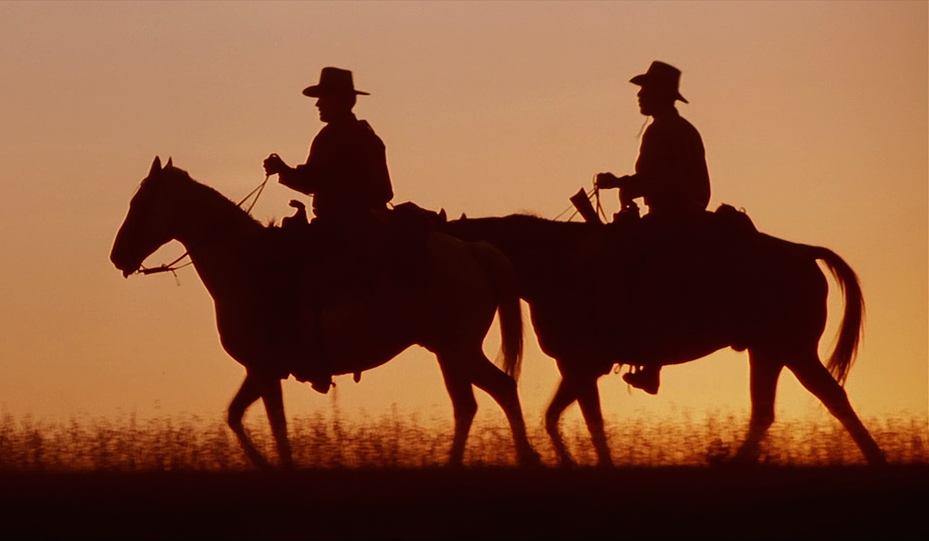 Now Eastwood is back in the saddle again–this time as director and star of “Unforgiven,” an ambitious film whose aim is to tell a story and at the same time comment on Western heroism. Dark and somber in both thematics and visuals, the narrative deconstructs the mythic glamour of violence and the mythic heroism of the gunslinger, two of the more prominent features of classic Westerns.
“Unforgiven” is a point of departure for Eastwood as an actor and director. The movie demythologizes effectively the Western hero as we used to know him from countless Hollywood movies. Eastwood consciously set out to humanize his superhero image in the Leone’s Westerns and also in films that are not explicitly Westerns, but have used elements of the genre, such as Dirty Harry, which is actually an urban Western. In a recent interview, Eastwood said: “The film demythologizes idolizing people for violent behavior.”
Our Grade: A- (**** out of *****)
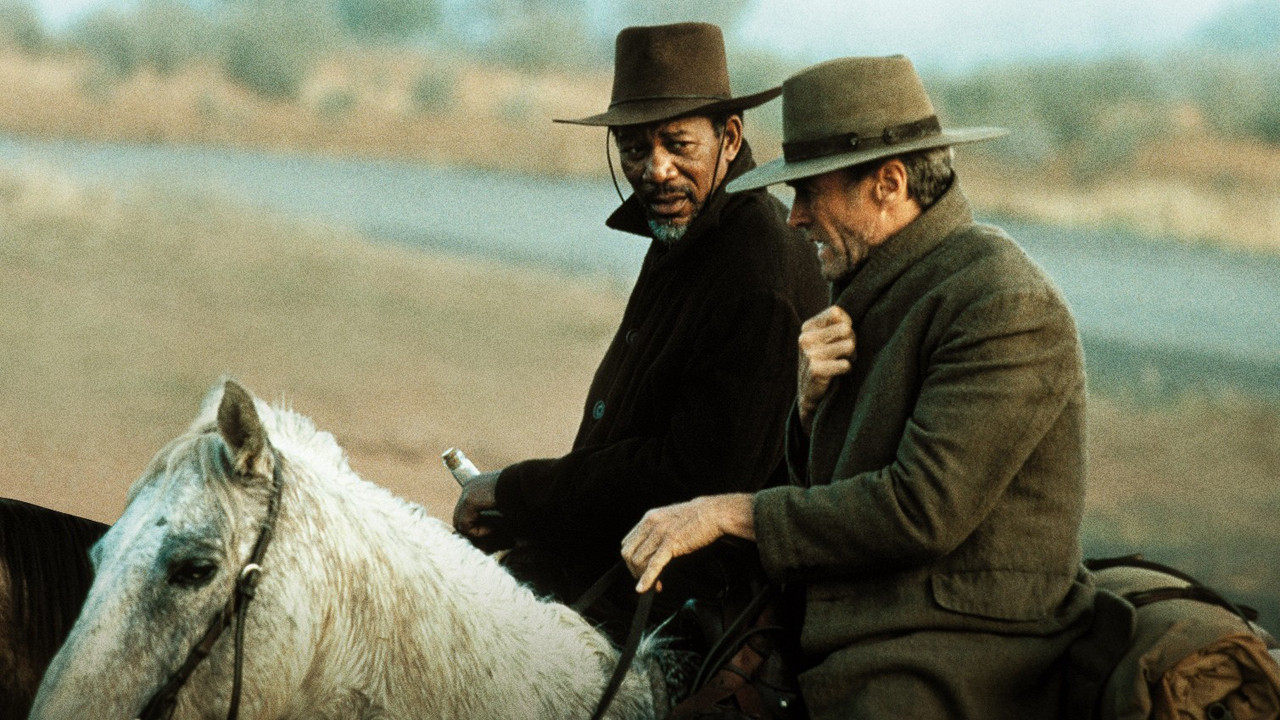 Eastwood did his homework before directing this movie. He obviously observed the character roles that John Wayne played at the end of his career, most notably the fat, one-eyed Rooster Cogburn in the Oscar-winning performance in “True Grit” (1969), directed by Henry Hathaway. In “Unforgiven,” Eastwood plays William Munny, an aged, down on his luck hog farmer and a widower raising two children. In fact, in the very first scene, the haggard-looking Munny is seen on his knees in the mud. Later, when he joins a young bounty hunter to avenge the two villains who cut a prostitute’s face with a Bowie knife, it is clear he is doing it for the money he desperately needs for his farm.
The pacing is intentionally leisurely, allowing the viewers time to think about the characters and how they deviate from the more typical ones (both heroes and villains) in classic Western films.
This film may remind you not only of Eastwood’s previous roles, but also of Alan Ladd’s outsider in “Shane,” Gregory Peck’s doomed gunslinger in “The Gunfighter,” and the two elderly gunfighters in Peckinpah’s elegiac “Ride the High Country.”
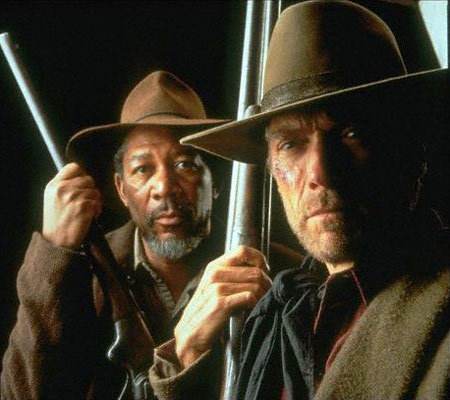 Yet the caliber of acting is uniformly high, which compensates for the movie’s other shortcomings. For starters, “Unforgiven” features Eastwood’s most mature screen work to date. His performance is multi-shaded, providing much wider range and expressiveness than his acting in former movies, which mostly relied on his quiet, self-effacing manner.
The reliable Gene Hackman gives another good performance as the vicious and cold-blooded sheriff. Hackman’s screen image is so contemporary that, at first, it’s somehow hard to imagine him in the Old West. Morgan Freeman, as Eastwood’s companion, and Richard Harris, as a greedy Englishman, excel in smaller but sharply defined roles.
Frances Fisher as the matter-of-fact madam lends a strong screen presence to a film that is otherwise dominated by men.
The only Native American woman in the cast is married to Morgan Freeman, Eastwood’s African-American sidekick.
A feminist streak runs through Unforgiven, even if most of the female characters are hookers. At heart, “Unforgiven” is a revisionist film, in which the hero confronts patriarchy, and attacks the notion of the Westerner’s gun as a reflection or extension of his phallus.
Whether consciously or not, the narrative makes a distinction between penis and phallus. The text is propelled by an incident, in which a prostitute showed contempt for a man’s small-size penis. That he happens to be a cowboy makes things worse. Strawberry Alice explains: “All she (Delilah) did, when she saw he had a teeny little pecker was give a giggle. She didn’t know no better.” Hence her attitude is perceived as one toward the power which is associated with phallus.
The concern continues when Bob shoots Cocoran, because he had a large penis he was sticking into a French woman that Bob liked.
Origins: Good Movies Come From
The script was written by David Webb Peoples, who wrote the Oscar nominated film The Day After Trinity and co-wrote Blade Runner with Hampton Fancher. The film’s concept goes back to 1976, when it was developed under the titles The Cut-Whore Killings and The William Munny Killings. Eastwood was given the script in the early 1980s, although he did not immediately pursue it
Westerns at the Oscars
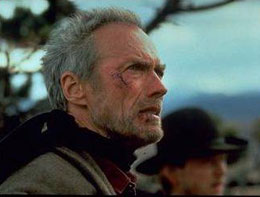
You can count the number of Western films over the last decade on two hands, and the recent big studio movies, Larry Kasdan’s “Silverado” and Eastwood’s own “Pale Rider,” were disappointing.
Kevin Costner’s “Dances With Wolves,” which swept all the 1990 Oscar Awards, is also a Western movie, though the focus is on a revisionist view of the Native Americans.
“Unforgiven,” which bears no relation to the John Huston movie of the same title, shows progress in Eastwood’s work as a director. The movie is dedicated to his two mentors: Sergio Leone, of his 1960s Spaghetti Westerns, and Don Siegel, who made with Eastwood some of his most popular movies (Dirty Harry, Escape from Alcatraz).
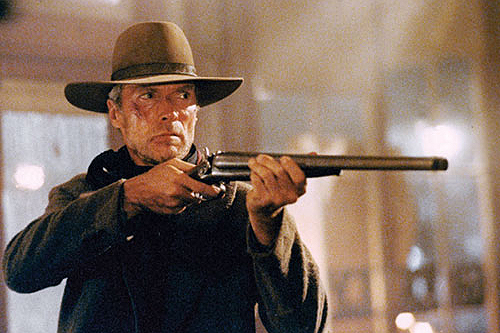 Released in the summer of 1992, Unforgiven was one of the few substantial American movie with “something to say,” rather than just offer frills and thrills of summer popcorn flicks. Surprisingly, this myth-debunking meditation on the savagery of the Old West was a critical and box-office smash, particularly after earning four Oscars, including Best Picture, Director for Eastwood, and Supporting Actor for Hackman.
Cast
William Munny (Clint Eastwood)
Sheriff “Little Bill” Daggett (Gene Hackman)
Ned Logan (Morgan Freeman)
English Bob (Richard Harris)
The “Schofield Kid” (Jaimz Woolvett)
W.W. Beauchamp (Saul Rubinek)
Strawberry (Frances Farmer)
Delilah Fitzgerald (Anna Thomson)
Quick Mike (David Mucci)
Davey Bunting (Rod Campbell)
Credits
Running time: 130 Minutes