With the exception of “Talk to Her,” the 2003 feature in which the two protagonists are men (and straight men at that), and “Bad Education,” there are not many men in Almodovar’s films. At times, there are no men at all, and if there are, the men are in the periphery. The few males are one-dimensional and treated as disposable objects, often violently killed by women in brutal acts of murder. In contrast, the female characters in his work are finely nuanced and complex in terms of motivation, psychology, and conduct.
Almodovar celebrates women because, as he has said time and again, “Women are the ones who run the whole gamut.” What’s consistent about his oeuvre is the indefatigable and incorrigible optimism of Almodovar’s heroines, despite the odds inherent in their existence. Almodovar believes that women are much closer to their emotions than men. Women are more concerned with–and more willing to be embarrassed and undignified in–their pursuit of love, which for him is the highest goals. But women need men, especially for sex, which makes them more vulnerable and dependable.
The turning point in Almodovar’s career occurred in 1988, with the release of “Women on the Verge of Nervous Breakdown” (“Mujeres al borde de un ataque de nervios”), which established his status on an international scale, not to mention the fact that the movie became the biggest box-office hit in Spanish history to date. Since then, Almodovar has been the most famous and recgnized Spanish director in the world, surpassing in popularity his elder peers (Carlos Saura, Victor Erice) and contemporaries (Bigas Luna, Fernando Trueba).
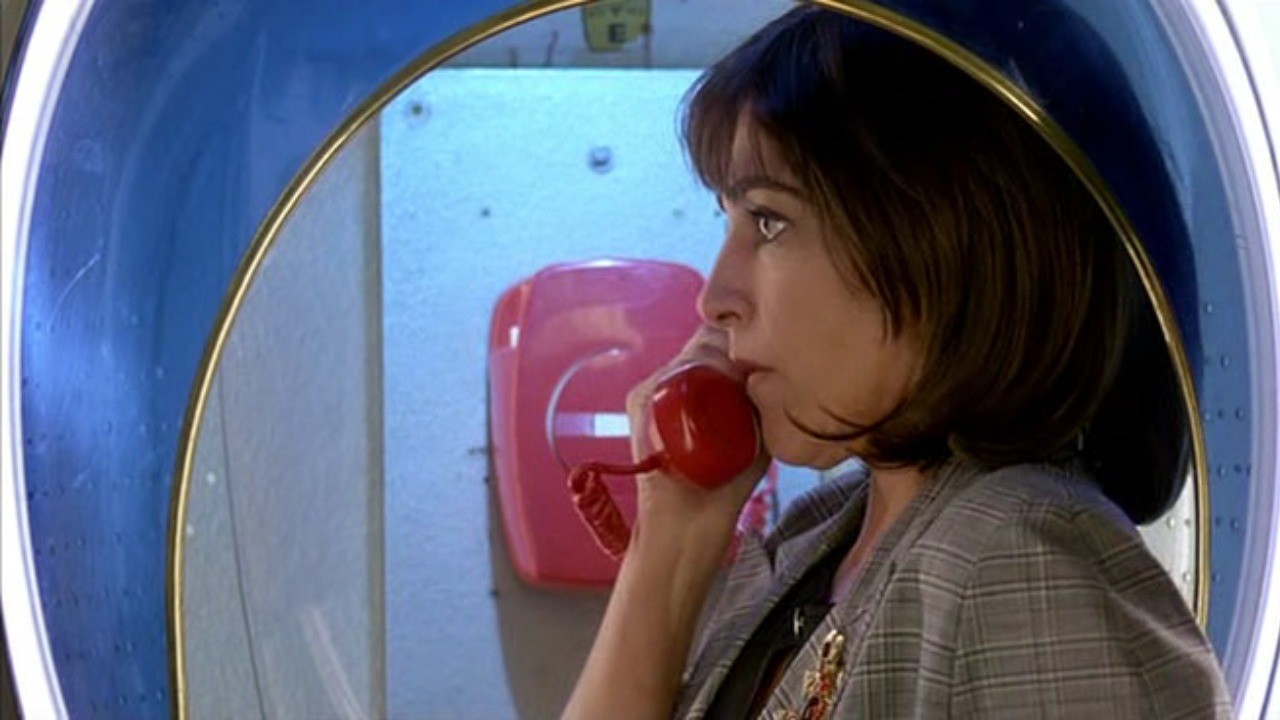 “Women on the Verge of Nervous Breakdown,” Almodovar’s first acknowledged masterpiece, is a sexy romp about obsessive love in all its shapes and forms. The elements of gaiety, melodrama, and hysterics are all merged together effectively, resulting in Almodovar’s most satisfying and commercially successful work to date. “Women on the Verge” was named best foreign film by the New York Film Critics Circle (NYFCC) , and Almodovar was named best young director at the EFA (European Film Awards). The film also won best screenplay at Venice Film Festival, where it had received its world premiere.
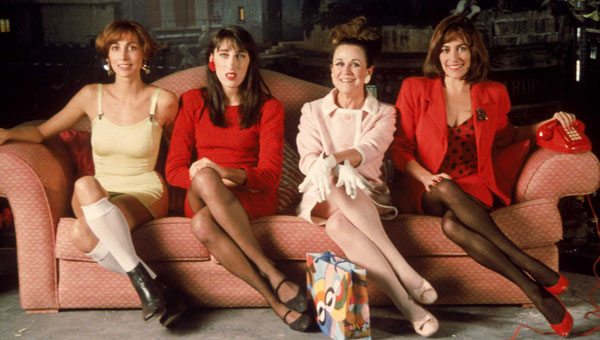
With “Women on the Verge,” Almodovar consolidated his reputation as a moviemaker, demonstrating ease at inventing stunning visual gags and fluent if bizarre social interactions. The hot color palette, dominated by red and pink, accentuates the fast-paced events from the opening credits to the closing frames. Flushed with bright lights and cartoonish hues, the movie pays homage to the visual strategy of Frank Tashlin, among others. Almodovar has also acknowledged that for his film he tried to adopt the frantic pace and absurdities of zany Hollywood screwball comedies of the 1930s and 1940s, such as Hawks’ “Bringing Up Baby” and “His Girl Friday.”
 Based on a series of missed connections and funny coincidences, the narrative is triggered by a single event. Ivan (Fernando Guillen), a desirable middle-aged married man, abruptly abandons his longtime lover Pepa (Carmen Maura), unaware that she is pregnant with his child. Desperate, Pepa is frantically trying to track down her elusive lover, first via hysterical phone messages, then via more personal and dangerous pursuits, finally encountering him in person by ironically saving his life. Pepa’s search unfolds as a road movie, replete with loopy drives and chases by any form of transportation, taxicabs (always driven by the same blond and jolly driver, extremely well played by Guillermo Montesinos), cars, and even motorcycles.
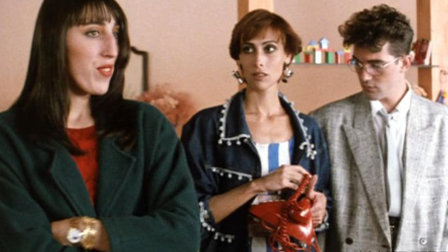
In the course of the pursuit, Pepa meets the various women in Ivan’s life, including his crazy wife, Lucia (Julieta Serrano), by whom he has fathered a now-grown-up son, Carlos (Antonio Banderas). That Carlos is shy and insecure is reflected in the way he looks (eye-glasses) moves (he walks slowly) and gentle naivete with women. The female antagonists are initially anonymous to each other. Lucia first spots Pepa placing a message on the door of their apartment. The jealous wife then removes the message and throws it into the garbage can, while Pepa secretly observes her act. Rest assured that this piece of paper would turn up later in the plot. Almodovar pays a personal tribute to Hitchcock’s “Rear Window,” when Pepa sits on a street bench and observes the windows of Ivan’s building, zeroing in on a young woman who exercises, just as Miss Torso did in Hitchcock’s 1954 classic.
 Though belonging to a different social class, Pepa, just like Gloria in “What Have I Done to Deserve This,” is distraught and depressed to the point of contemplating suicide (emphasis on contemplating). As punishment and revenge, Pepa prepares a batch of gazpacho laced with barbiturates meant for Ivan. Observed in close-up, Pepa chops the hot-red and ripe tomatoes with a sharp knife, cutting herself in the process in a minor injury. In a moment of revelation, she takes one pill for herself, and dumps the rest of package into the uniquely Spanish drink. Assuming a life of its own, the gazpacho then becomes a key to some strange, unexpected events. Since “Women on the Verge” is structured as a farce, it is anticipated that all the “wrong” individuals, except for Ivan, would drink the gazpacho at one point or another.
Looking for a change, Pepa puts her apartment up for rent. Let the parade begin: Soon, all kinds of bizarre people show up at the luxurious flat. When she is around, Pepa functions as the hostess, at one point even entertaining two local policemen. Not surprisingly, the cops prove stupid and ineffectual, drinking the gazpacho and falling asleep, when they are most needed. When Pepa is not around, which is half of the time, other guests assume the role of hosts, with varying degrees of success. The bell rings and doors are opened and closed with frequent regularity and sharp precision, as are the norm of bedroom farces.
Pepa’s penthouse and its large terrace are introduced as dawn descends over Madrid, seen in heavy pollution. Though an urban dweller, Pepa has fulfilled her desire to live in the country, so to speak. She has palm trees with birds, a little yard with hens, which refuse to “behave” when she talks to them, a cock that crows, and several rabbits. Every element of this urban farm is designed with cheerfully perverse taste that’s slightly kitschy, but not in an offensive way. Pepa enjoys watering her plants and trees with a long hose, feeding her family of animals, socializing with them on the rare occasion that she’s alone.
 Like the dichotomies in the narrative, Pepa’s space is defined by a series of binary oppositions: Country and city, upper and lower class, men and women, husbands and wives, fathers and sons, spouses and mistresses, older and younger femmes, authority figures and ordinary civilians. The movie belongs to a genre described by Almodovar as “Alta Comedia,” or “high comedy,” defined as a “comedy of manners characterized by anti-naturalism: The sets are deliberately artificial, the performances and dialogues excessively rapid, and the deepest human ambitions treated in an abstract, almost synthetic manner.” “I am sick of being good,” Pepa says while putting the sleeping pills into her gazpacho as a trap for Ivan.
In the opening act, a voice-over is heard in a black-and white scene that shows an older man surrounded by many women. When the camera pulls back, we realized it’s Pepa’s voice narrating a monochromatic dream, which reflects her anxieties over Ivan’s betrayals. The women in the dream, clad in different dresses, walk toward Ivan, noticed or unnoticed by him, in a parade that recalls sequences in Fellini’s “81/2,” made in 1963, and also shot in black-and white. The black-and-white dream parallels and would reaffirm the reality of Pepa’s life, albeit in color.
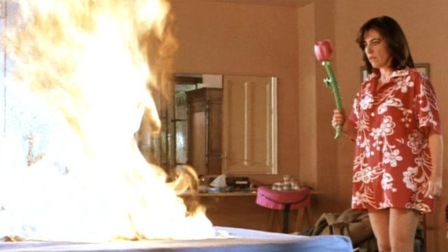
Later, lighting a cigarette, Pepa sets her bed aflame by accident. Staring into the flames, she seems strangely excited, even thrilled by the sight, dreaming of a bigger apocalypse. However, snapping out of her fantasy, Pepa throws her cigarette into the fire and immediately goes for the hose. Eccentric and crazy as Pepa is, she is not stupid. Almodovar’s women can be dreamers and losers, but only for a while—and up to a point. Eventually, they all get up on their solid feet and wear their sexy high heels (the title of Almodovar’s 1995 picture).
 The film’s initial reel has an unsettled rhythm, defined by sudden shifts in the plot’s large number of locales and personas. There are at least ten speaking characters all fully developed. Pepa is first seen passive, asleep, and the ensuing tale is about waking-up, getting in touch with her inner feelings by gaining self-consciousness. Almodovar’s femmes may be flighty, spontaneous, tempestuous, and driven to momentary madness, but ultimately, they are pragmatic and sane, motivated by common sense rather than intellect and fueled by newly-formed female friendship or community.
The aging Ivan and the younger (but not young) Pepa both work in the film industry. Pepa is doing some commercials (one about detergent is seen), but her main job is dubbing. Ivan and Pepa offer the Spanish voices for the roles of Sterling Hayden and Joan Crawford, respectively, in Nicholas Ray’s 1954 cult Western “Johnny Guitar,” which Almodovar, like many other cinephiles, greatly admires. The dubbing sequences are as crucial as the movie chosen for them to dub. Each addresses only the microphone and the screen—there is lack of reciprocity since they are not physically present at the same time. Moreover, the dialogue offers an ironic commentary on their “relationship,” when Hayden’s Johnnie is begging Crawford’s Vienna “to deceive” him, namely, to tell him that she loves him as much as he loves her. This phrase is ironic as Hayden has almost always played “macho” roles (“Asphalt Jungle”) and “Johnny Guitar” is the exception to the norm, casting him in a more vulnerable role. More significantly, in “Women on the Verge,” it’s the female, Pepa, who’s desperate to know whether Ivan loves her as much as she loves him—or loves her at all, as Ivan plans to leave town for a vacation with his latest mistress.
As the protagonist, Pepa is contrasted with half a dozen women. First, there is her weepy friend Candela (Maria Barranco), who is wearing earrings in the shape of espresso machines. In her big scene, delivered in tears, while making us laugh, Candela tells of her affair with a Shiite terrorist who had used her apartment as a meeting place. She now fears that the police would arrest her as a crime accessory, perhaps even conspirator. Candella is seen, just like Pepa, packing the belongings of her (unseen) terrorist lover in a suitcase, which she buries in a public dumpster. In contrast, Pepa’s suitcase with Ivan’s possessions and love letters goes from one hand to another, again obeying the rules of the farce genre. At the end, the suitcase lands in a big public garbage dumpster and is conveniently retrieved by Ivan’s current lover, who just happens to be sitting nearby in her car.
The second contrast is offered by Marisa, played by the iconic star Rosy de Palma, known for her cubist face– her extraordinary long and crooked nose–which gives her a distinctive look. Dressed in sensual red, like several of the other women, Marisa first turns up at Pepa’s apartment with her boyfriend Carlos, who just happens to be Ivan’s son. When Marisa, among others, drinks the gazpacho intended for Ivan, she falls into a sleep that induces a wet erotic dream in which she experiences her first orgasm ever. This is Almodovar’s satiric stab at men who brag about sexual prowess—here, it takes a surreal reverie for a virginal girl to have her first climax. Meanwhile, the virginal Carlos courts Candella, before falling asleep with her in his arms; the way he caresses her breasts suggests that he has never done it before.
Almodovar’s description of the setting illustrates his theory of happiness, his utopian manifesto: “Society has now adapted itself to individuals, and all their social and professional needs have been met.” For him, the most significant human goal is to be happy–or unhappy–with the person you love. Love is sacred value, and the highest goal in life. Sex in Almodovar’s movies is both dreamy (and dream-like) and realistic, exciting and messy, fulfilling and dangerous. It’s an activity and performance carried out in complete abandonment and total immersion, to the exclusion of other interests. However, as an all-encompassing act, sex is often humiliating in its obsessive pursuit, and hot sex can be dangerous and risky to the point of death, as it was in “Matador.”
Though Ivan offers the dramatic connection among the characters, he is only shown in brief glimpses, walking down the street, making a call out of a phone booth, hiding from his crazy wife, or recording in a studio. Almodovar reduces Ivan’s presence to a voice talking to a microphone in a close-up. An aging, dwindling Lothario, he is deliberately an underdeveloped character, a philandering husband blessed with an erotic voice that proves alluring to women. He is really fully seen, and given some dialogue, in the last sequence, set at the airport, when he is about to depart for a vacation with yet another younger mistress.
In the preceding scene, there is a serio-comic confrontation between Pepa and Ivan’s wife, Lucia. Both are holding a glass of gazpacho, but knowing its contents, they refuse to drink it. Breaking the impasse, Lucia dumps the gazpacho on Pepa’s face and runs out. At a gun point, Lucia forces a punkish motorcyclist who just happens to be outside the building to take her to the airport. Fearing the potential consequences, Pepa rushes out in a taxicab (the same one, driven by Almodovar) to the airport. A chase scene with shoot-outs ensues in a mock satirical way of Hollywood’s more notorious chase scenes. At the terminal, just when Lucia is about to shoot Ivan, standing on line with his mistress, Pepa saves his life by pushing a luggage cart at the mad wife before fainting herself. Spotting Pepa, now in the role of his life-savior, Ivan rushes towards her, holding her in his arms while apologizing for his behavior. But, alas, it’s too late. Finally sober and in control of her emotions and actions, Pepa realizes that Ivan is really not worthy of her love. Ivan, and by implication all men, are big liars and phony performers. This upbeat messagy ending is reinforced by the song “Teatro.”
The discussion of this film began with analysis of Pepa’s space and should conclude by suggesting that while the penthouse is a fixed space, initially, it doesn’t qualify as a home. For most of the story, the apartment is just a physical site that Pepa leaves and returns to, only to leave again. Before each departure, she makes sure to be dressed elegantly and made-up properly. Throughout the tale, Pepa’s space is visited or invaded by her amigas and strangers (the cops, the couple looking to rent it, Ivan’s wife). Crucial to Pepa’s journey of self-discovery is the realization that the penthouse is her real home, and as such, should function as a place of stability and happiness.
For every death in Almodovar’s films there’s birth, for every terminated relationship a new one is formed. In the last shot of “Women on the Verge,” all the invaders and guests have left, except for one. Pepa is joined by Marisa, and the two have a toast to their new friendship. Both women have been deluded by their relationships with men, who emotionally, no matter their age, are still boys. There is no chemistry or meaningful rapport between Marisa and Carlos; they look more like siblings or classmates than lovers.
In celebrating female camaraderie, Almodovar reaffirms the endings of such classic Hollywood melodramas as “Old Acquaintance,” in which the initial rivals (Better Davis and Miriam Hopkins) have a drink in front of the fireplace, a closure that the gay director George Cukor had also chosen for the 1981 “Rich and Famous,” the loose remake of the 1941 Warner’s melodrama, showing Candice Bergen and Jacqueline Bisset with a champagne glass in their hands, seated in front of the fireplace on new Year’s. Cukor’s denouement, in what became his very last feature, is again explicitly referenced in the text of Almodovar’s 1995 “The Flower of My Secret.”
Again proving he is a great actors’ director, Almodovar has coaxed superb performances out of his large, uniformly skillful cast. Carmen Maura, an Almodovar regular and consummate farceuse, brings out with remarkable energy and authenticity the pathos, the tragic, but also the joyous elements of the farcical melodrama about a dejected woman. It’s not a coincidence that most of this picture’s stars, including Maura, De Palma, and especially Antonio Banderas, went on to become major stars of Spanish and international cinema.